what does it take to get someone committed
Involuntary commitment, ceremonious commitment, involuntary hospitalization or involuntary hospitalisation (Commonwealth English; see spelling differences), (also known informally as sectioning or being sectioned [i] in some jurisdictions, such equally the United Kingdom)[ii] is a legal process through which an individual who is accounted past a qualified agent to take symptoms of severe mental disorder is detained in a psychiatric hospital (inpatient) where they tin be treated involuntarily. This treatment may involve the assistants of psychoactive drugs, including involuntary administration. In many jurisdictions, people diagnosed with mental health disorders tin can also be forced to undergo handling while in the customs; this is sometimes referred to as outpatient commitment and shares legal processes with commitment.
Criteria for civil commitment are established by laws which vary between nations. Commitment proceedings often follow a period of emergency hospitalization, during which an private with astute psychiatric symptoms is confined for a relatively brusk duration (due east.thousand. 72 hours) in a treatment facility for evaluation and stabilization by mental health professionals who may then make up one's mind whether further civil commitment is advisable or necessary. Civil commitment procedures may take place in a courtroom or only involve physicians. If commitment does not involve a court there is normally an appeal process that does involve the judiciary in some capacity, though potentially through a specialist courtroom.[a]
Historically, until the mid-1960s in most jurisdictions in the Usa, all committals to public psychiatric facilities and nigh committals to private ones were involuntary. Since then, at that place have been alternate trends towards the abolition or substantial reduction of involuntary delivery,[5] a trend known equally deinstitutionalisation. In many currents, individuals can voluntarily acknowledge themselves to a mental wellness hospital and may take more than rights than those who are involuntarily committed. This practice is referred to every bit voluntary delivery.
In the United States, an indefinite form of commitment is practical to people bedevilled of some sexual offences.[ citation needed ]
Purpose [edit]
For almost jurisdictions, involuntary delivery is applied to individuals believed to be experiencing a mental illness that impairs their power to reason to such an extent that the agents of the law, state, or courts decide that decisions will be made for the individual under a legal framework. In some jurisdictions, this is a proceeding distinct from existence constitute incompetent. Involuntary commitment is used in some degree for each of the following although unlike jurisdictions take dissimilar criteria. Some jurisdictions limit involuntary treatment to individuals who meet statutory criteria for presenting a danger to self or others. Other jurisdictions have broader criteria. The legal process past which commitment takes place varies between jurisdictions. Some jurisdictions have a formal courtroom hearing where testimony and other testify may also exist submitted and the discipline of the hearing is typically entitled to legal counsel and may challenge a commitment order through habeas corpus.[6] Other jurisdictions have delegated these power to physicians,[3] though may provide an appeal process that involves the judiciary but may also involve physicians.[b] For example in the UK a mental health tribunal consists of a approximate, a medical member, and a lay representative.[c]
Outset assist [edit]
Grooming is gradually condign available in mental health first aid to equip customs members such as teachers, school administrators, police officers, and medical workers with training in recognizing, and authorisation in managing, situations where involuntary evaluations of behavior are applicable under law.[9] The extension of first aid training to cover mental wellness issues and crises is a quite recent development.[10] [11] A mental health first assist grooming class was adult in Commonwealth of australia in 2001 and has been found to improve aid provided to persons with an alleged mental affliction or mental health crunch. This form of training has now spread to a number of other countries (Canada, Finland, Hong Kong, Ireland, Singapore, Scotland, England, Wales, and the United States).[12] Mental health triage may exist used in an emergency room to make a conclusion about potential risk and employ treatment protocols.
Ascertainment [edit]
Observation is sometimes used to determine whether a person warrants involuntary commitment. Information technology is not always clear on a relatively brief test whether a person should be committed.
Containment of danger [edit]
Republic of austria, Belgium, Germany, State of israel, the netherlands, Northern Ireland, Russia, Taiwan, Ontario (Canada), and the United States have adopted commitment criteria based on the presumed danger of the defendant to self or to others.[13]
People with suicidal thoughts may act on these impulses and harm or kill themselves.
People with psychosis are occasionally driven by their delusions or hallucinations to harm themselves or others. Enquiry has constitute that those who suffer from schizophrenia are betwixt three.4 and seven.iv times more than likely to appoint in fierce behaviour than members of the full general public. [14] However, because other confounding factors such as babyhood arduousness and poverty are correlated with both schizophrenia and violence it can exist difficult to make up one's mind whether this effect is due to schizophrenia or other factors. In an try to avert these misreckoning factors, researchers accept tried comparing the rates of violence amongst people diagnosed with schizophrenia to their siblings in a similar manner to twin studies. In these studies people with schizophrenia are found to exist betwixt 1.3 and 1.8 times more than probable to engage in violent behaviour.[14]
People with certain types of personality disorders tin can occasionally present a danger to themselves or others.[15]
This business concern has found expression in the standards for involuntary delivery in every U.s. land and in other countries equally the danger to cocky or others standard, sometimes supplemented past the requirement that the danger be imminent. In some jurisdictions,[ which? ] the danger to self or others standard has been broadened in contempo years to include need-for-treatment criteria such as "gravely disabled".[sixteen]
Deinstitutionalization [edit]
Starting in the 1960s, at that place has been a worldwide trend toward moving psychiatric patients from hospital settings to less restricting settings in the community, a shift known as "deinstitutionalization". Considering the shift was typically non accompanied by a commensurate development of customs-based services, critics say that deinstitutionalization has led to big numbers of people who would in one case have been inpatients as instead being incarcerated or becoming homeless.[17] In some jurisdictions, laws authorizing courtroom-ordered outpatient handling have been passed in an endeavour to compel individuals with chronic, untreated severe mental affliction to take psychiatric medication while living outside the infirmary (e.grand. Laura'south Law, Kendra's Law).[18] [19]
Before the 1960s deinstitutionalization there were earlier efforts to free psychiatric patients. Philippe Pinel (1745–1826) ordered the removal of chains from patients.[20]
In a study of 269 patients from Vermont Country Hospital done by Courtenay M. Harding and assembly, well-nigh two-thirds of the ex-patients did well after deinstitutionalization.[21]
Around the world [edit]
French republic [edit]
In 1838, France enacted a police to regulate both the admissions into asylums and aviary services across the country. Édouard Séguin adult a systematic approach for training individuals with mental deficiencies,[22] and, in 1839, he opened the starting time school for the intellectually disabled. His method of handling was based on the idea that the intellectually disabled did non suffer from illness.[23]
United Kingdom [edit]
In the United Kingdom, provision for the care of the mentally ill began in the early 19th century with a state-led endeavour. Public mental asylums were established in Great britain after the passing of the 1808 Canton Asylums Act. This empowered magistrates to build charge per unit-supported asylums in every canton to business firm the many "pauper lunatics". Nine counties first practical, and the first public aviary opened in 1812 in Nottinghamshire. Parliamentary Committees were established to investigate abuses at private madhouses like Bethlem Hospital - its officers were somewhen dismissed and national attention was focused on the routine use of bars, chains and handcuffs and the filthy atmospheric condition the inmates lived in. Yet, it was not until 1828 that the newly appointed Commissioners in Lunacy were empowered to license and supervise individual asylums.
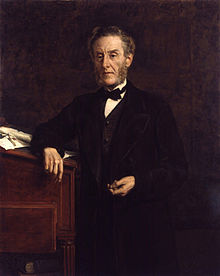
The Lunacy Act 1845 was a landmark in the treatment of the mentally sick, as it explicitly changed the status of mentally ill people to patients who required treatment. The Deed created the Lunacy Commission, headed by Lord Shaftesbury, focusing on reform of the legislation concerning lunacy.[24] The commission consisted of eleven Metropolitan Commissioners who were required to carry out the provisions of the Act;[25] [ full commendation needed ] the compulsory structure of asylums in every canton, with regular inspections on behalf of the Habitation Secretarial assistant. All asylums were required to have written regulations and to have a resident qualified physician.[25] A national body for asylum superintendents - the Medico-Psychological Association - was established in 1866 under the Presidency of William A. F. Browne, although the body appeared in an earlier form in 1841.[26]
At the turn of the century, England and France combined had only a few hundred individuals in asylums.[27] By the late 1890s and early 1900s, those and then detained had risen to the hundreds of thousands. Even so, the idea that mental affliction could exist ameliorated through institutionalization was soon disappointed.[28] Psychiatrists were pressured past an ever-increasing patient population.[28] The boilerplate number of patients in asylums kept increasing.[28] Asylums were quickly condign almost indistinguishable from custodial institutions,[29] and the reputation of psychiatry in the medical world had hit an extreme low.[xxx]
United States [edit]
In the The states, the erection of state asylums began with the first law for the creation of 1 in New York, passed in 1842. The Utica State Hospital was opened approximately in 1850. The creation of this infirmary, every bit of many others, was largely the piece of work of Dorothea Lynde Dix, whose philanthropic efforts extended over many states, and in Europe every bit far as Constantinople. Many land hospitals in the U.s.a. were built in the 1850s and 1860s on the Kirkbride Plan, an architectural style meant to have curative outcome.[31]
In the U.s.a. and most other adult societies, severe restrictions take been placed on the circumstances under which a person may exist committed or treated confronting their will as such deportment have been ruled past the U.s. Supreme Court and other national legislative bodies as a violation of civil rights and/or human rights. The Supreme court example O'Connor 5. Donaldson established that the mere presence of mental illness and the necessity for treatment are not sufficient by themselves to justify involuntary commitment, if the patient is capable of surviving in freedom and does not present a danger of impairment to themselves others. Criteria for involuntary commitment are mostly fix by the individual states, and oftentimes accept both short- and long-term types of commitment. Short-term commitment tends to be a few days or less, requiring an test by a medical professional, while longer-term delivery typically requires a court hearing, or sentencing as function of a criminal trial. Indefinite delivery is rare and is usually reserved for individuals who are violent or nowadays an ongoing danger to themselves and others. Kansas v. Hendricks established the procedures for indefinite commitment of sex offenders.
United nations [edit]
United Nations General Assembly Resolution 46/119, "Principles for the Protection of Persons with Mental Illness and the Improvement of Mental Health Intendance", is a non-binding resolution advocating sure broadly drawn procedures for the carrying out of involuntary commitment.[32] These principles have been used in many countries[ which? ] where local laws have been revised or new ones implemented. The United nations runs programs in some countries to aid in this process.[33]
Criticism [edit]
The dangers of institutions were chronicled and criticized by reformers well-nigh since their foundation. Charles Dickens was an outspoken and high-profile early on critic, and several of his novels, in detail Oliver Twist and Hard Times demonstrate his insight into the damage that institutions can do to human being beings.
Enoch Powell, when Minister for Health in the early 1960s, was a later opponent who was appalled by what he witnessed on his visits to the asylums, and his famous "h2o belfry" speech communication in 1961 called for the closure of all NHS asylums and their replacement by wards in general hospitals:
"There they stand, isolated, majestic, imperious, brooded over by the gigantic water-belfry and chimney combined, rising unmistakable and daunting out of the countryside - the asylums which our forefathers congenital with such immense solidity to express the notions of their day. Do not for a moment underestimate their powers of resistance to our assault. Let me depict some of the defenses which we have to storm."[34]
Scandal later scandal followed, with many high-profile public inquiries.[35] These involved the exposure of abuses such as unscientific surgical techniques such as lobotomy and the widespread neglect and corruption of vulnerable patients in the US and Europe. The growing anti-psychiatry movement in the 1960s and 1970s led in Italia to the first successful legislative challenge to the authorisation of the mental institutions, culminating in their closure.
During the 1970s and 1990s the infirmary population started to fall rapidly, mainly because of the deaths of long-term inmates. Significant efforts were made to re-house large numbers of former residents in a variety of suitable or otherwise alternative accommodation. The beginning 1,000+ bed hospital to shut was Darenth Park Infirmary in Kent, swiftly followed by many more across the UK. The haste of these closures, driven by the Conservative governments led by Margaret Thatcher and John Major, led to considerable criticism in the printing, as some individuals slipped through the cyberspace into homelessness or were discharged to poor quality private sector mini-institutions.
Wrongful involuntary commitment [edit]
Mental health professionals have, on occasion, wrongfully deemed individuals to have symptoms of a mental disorder, and thereby commit the individual for treatment in a psychiatric hospital. Claims of wrongful delivery are a common theme in the anti-psychiatry movement.[36] [37] [38]
In 1860, the example of Elizabeth Packard, who was wrongfully committed that year and filed a lawsuit and won thereafter, highlighted the issue of wrongful involuntary commitment.[39] In 1887, investigative announcer Nellie Bly went hush-hush at an asylum in New York City to betrayal the terrible conditions that mental patients at the time had to bargain with. She published her findings and experiences equally articles in New York World, and after made the articles into one book called Ten Days in a Mad-House.
In the beginning half of the twentieth century there were a few high-profile cases of wrongful commitment based on racism or penalization for political dissenters. In the former Soviet Matrimony, psychiatric hospitals were used as prisons to isolate political prisoners from the rest of gild. British playwright Tom Stoppard wrote Every Good Boy Deserves Favour about the relationship betwixt a patient and his doctor in one of these hospitals. Stoppard was inspired by a coming together with a Russian exile.[xl] In 1927, after the execution of Sacco and Vanzetti in the United States, demonstrator Aurora D'Angelo was sent to a mental health facility for psychiatric evaluation after she participated in a rally in support of the anarchists.[41] [42] [ pages needed ] Throughout the 1940s and 1950s in Canada, 20,000 Canadian children, called the Duplessis orphans, were wrongfully certified as beingness mentally ill and as a result were committed to psychiatric institutions where they were allegedly forced to take psychiatric medication that they did not need and were driveling. They were named after Maurice Duplessis, the premier of Quebec at the time, who deliberately committed these children to in order to misappropriate additional subsidies from the federal government.[43] Decades later in the 1990s, several of the orphans sued Quebec and the Cosmic Church building for the abuse and wrongdoing.[44] In 1958, blackness pastor and activist Clennon Washington Rex Jr. tried enrolling at the University of Mississippi, which at the time was white, for summertime classes; the local police secretly arrested and involuntarily committed him to a mental hospital for 12 days.[45] [46]
Patients are able to sue if they believe that they have been wrongfully committed.[47] [48] [49] In one example, Junius Wilson, an African American man, was committed to Reddish Hospital in Goldsboro, N Carolina in 1925 for an alleged crime without a trial or conviction. He was castrated. He continued to be held at Ruby Infirmary for the next 67 years of his life. It turned out he was deaf rather than mentally ill.[50] [51] [52]
In many American states[53] sexual practice offenders who have completed a menses of incarceration can be civilly committed to a mental institution based on a finding of dangerousness due to a mental disorder.[54] Although the U.s. Supreme Court determined that this practise does not constitute double jeopardy,[55] organizations such as the American Psychiatric Association (APA) strongly oppose the practice.[56] The Job Force on Sexually Unsafe Offenders, a component of APA's Quango on Psychiatry and Constabulary, reported that "in the stance of the task force, sexual predator delivery laws represent a serious assault on the integrity of psychiatry, particularly with regard to defining mental illness and the clinical conditions for compulsory treatment. Moreover, by bending civil commitment to serve essentially non-medical purposes, statutes threaten to undermine the legitimacy of the medical model of commitment."[57] [58]
See too [edit]
- 5150 (involuntary psychiatric concur)
- Baker Act
- Civil solitude
- Conversion therapy
- Criminal justice
- Institutional syndrome
- John Hunt
- Medical constabulary
- Mental Health Human action 2007
- Special delivery heart
- Giorgio Antonucci
- Ulysses contract
In the creative arts [edit]
- Ane Flew Over the Cuckoo'southward Nest (novel), (1 Flew Over the Cuckoo's Nest (movie)), (One Flew Over the Cuckoo's Nest (play))
- if....
- Forrest Gump novel and motion picture based on the novel
- Cool Paw Luke
- Insubordinate without a Cause
Notes [edit]
- ^ See table ii, many countries such equally Commonwealth of australia, Denmark, England and Kingdom of spain practice not crave the involvement of the judiciary for commitment.[3] See [4] for a discussion of mental-health tribunals.
- ^ For a discussion of the role of physicians in mental health tribunals and its furnishings encounter [vii]
- ^ "The chair of each Mental Wellness Tribunal is a legal member who is known as a tribunal judge. There are unremarkably three tribunal members at a hearing, i legal member, one medical member, and one other member, as defined above. Whatever three or more such members, constituted in this manner, may practice the jurisdiction of a Mental Health Tribunal" [8] : 99
References [edit]
- ^ "Being sectioned (in England and Wales)". Regal College of Psychiatrists. August 2013.
- ^ "What does 'being sectioned' mean?". Rethink Mental Illness.
- ^ a b Rains, Luke Sheridan; Zenina, Tatiana; Dias, Marisa Casanova; Jones, Rebecca; Jeffreys, Stephen; Branthonne-Foster, Stella; Lloyd-Evans, Brynmor; Johnson, Sonia (2019-05-01). "Variations in patterns of involuntary hospitalisation and in legal frameworks: an international comparative written report". The Lancet Psychiatry. 6 (5): 403–417. doi:10.1016/S2215-0366(xix)30090-ii. ISSN 2215-0366. PMC6475657. PMID 30954479.
- ^ Macgregor, Aisha; Brown, Michael; Stavert, Jill (2019-04-16). "Are mental health tribunals operating in accordance with international man rights standards? A systematic review of the international literature". Wellness & Social Care in the Customs. Wiley. 27 (iv): e494–e513. doi:10.1111/hsc.12749. ISSN 0966-0410. PMID 30993806.
- ^ Hendin, Herbert (1996). Suicide in America. Due west. Westward. Norton. p. 214. ISBN978-0-393-31368-0. OCLC 37916353.
- ^ Texas Young Lawyers Clan (January 2008). "Committed To Healing: Involuntary Commitment Procedures" (PDF). Austin, TX: State Bar of Texas. p. 2.
The law provides a process known as Involuntary Commitment. Involuntary commitment is the use of legal means to commit a person to a mental hospital or psychiatric ward against their will or over their protests.
- ^ Thom, Katey; Nakarada-Kordic, Ivana (2013-05-22). "Mental Health Review Tribunals in Activity: A Systematic Review of the Empirical Literature". Psychiatry, Psychology and Police force. Informa United kingdom of great britain and northern ireland Express. 21 (1): 112–126. doi:10.1080/13218719.2013.790004. ISSN 1321-8719. S2CID 143237902.
- ^ Basant Puri; Robert Brown; Heather McKee; Ian Treasaden (28 July 2017). Mental Health Law 2EA Practical Guide. CRC Press. ISBN978-ane-4441-4975-three.
- ^ "Nigh". Mental Health Outset Assist USA. National Council for Behavioral Health. 2013-10-10. Retrieved 2013-12-21 .
- ^ Kitchener, Betty A.; Jorm, Anthony F. (1 October 2002). "Mental wellness outset aid training for the public: evaluation of effects on knowledge, attitudes and helping behaviour". BMC Psychiatry. 2: 10. doi:ten.1186/1471-244X-2-10. PMC130043. PMID 12359045.
- ^ Kitchener, Betty; Jorm, Anthony; Kelly, Claire (2010). Mental Health Commencement Assist Manual (2nd ed.). Parkville, Victoria: ORYGEN Youth Health Resources Centre. ISBN978-0-9805541-3-7. OCLC 608074743.
- ^ Kitchener, Betty A.; Jorm, Anthony F. (Feb 2008). "Mental health first assist: an international program for early intervention". Early Intervention in Psychiatry. 2 (1): 55–61. doi:10.1111/j.1751-7893.2007.00056.x. PMID 21352133. S2CID 11813019.
- ^ Appelbaum, Paul S. (June 1997). "Almost a Revolution: An International Perspective on the Law of Involuntary Commitment". Periodical of the American Academy of Psychiatry and the Law. 25 (2): 135–147. PMID 9213286.
- ^ a b Fazel, Seena; Gulati, Gautam; Linsell, Louise; Geddes, John R.; Grann, Martin (2009-08-11). McGrath, John (ed.). "Schizophrenia and Violence: Systematic Review and Meta-Analysis". PLOS Medicine. Public Library of Science (PLoS). vi (8): e1000120. doi:ten.1371/journal.pmed.1000120. ISSN 1549-1676. PMC2718581. PMID 19668362.
- ^ Sansone, Randy A.; Sansone, Lori (March ix, 2012). "Borderline Personality and Externalized Aggression". Innovations in Clinical Neuroscience. ix (iii): 23–26. PMC3342993. PMID 22567607.
- ^ Country STANDARDS FOR CIVIL Delivery. Arlington, Virginia: Handling Advocacy Center. 2018.
- ^ Dear, Michael J.; Wolch, Jennifer R. (1987). Landscapes of Despair: From Deinstitutionalization to Homelessness. Princeton, NJ: Princeton Legacy Library. ISBN9781400858965.
- ^ "Kendra'due south Police: Results from New York's First Ten Years with Assisted Outpatient Handling". Treatment Advocacy Center . Retrieved August 2, 2020.
- ^ A Guide to Laura's Constabulary: California'due south Law for Assisted Outpatient Treatment (PDF). The California Treatment Advocacy Coalition & The Treatment Advocacy Center. 2009.
- ^ "View of The Evolution of Public Health and Current Challenges: A Review". ihrjournal.com . Retrieved 2018-12-19 .
- ^ Harding, C.Thou.; Brooks, G.W.; Ashikaga, T.; Strauss, J.S.; Breier, A. (June 1987). "The Vermont longitudinal study of persons with severe mental illness, I: Methodology, study sample, and overall status 32 years later". American Periodical of Psychiatry. 144 (6): 718–26. doi:10.1176/ajp.144.6.718. PMID 3591991.
- ^ King, D. Brett; Viney, Wayne; Woody, William Douglas (2007). A History of Psychology: Ideas and Context (4 ed.). Allyn & Bacon. p. 214. ISBN9780205512133.
- ^ Editors of Encyclopædia Britannica (12 June 2013). "Edouard Seguin (American psychiatrist)". Encyclopædia Britannica.
- ^ Unsworth, Clive."Law and Lunacy in Psychiatry's 'Aureate Age'", Oxford Journal of Legal Studies. Vol. xiii, No. four. (Winter, 1993), pp. 482.
- ^ a b Wright, David: "Mental Wellness Timeline", 1999
- ^ Shorter, E. (1997), p. 34, 41
- ^ Shorter, E. (1997), p. 34
- ^ a b c Shorter, E. (1997), p. 46
- ^ Rothman, D.J. (1990). The Discovery of the Asylum: Social Guild and Disorder in the New Republic. Boston: Little Brownish, p. 239. ISBN 978-0-316-75745-4
- ^ Shorter, E. (1997), p. 65
- ^ Yanni, Carla (2007). The Architecture of Madness: Insane Asylums in the United States. Minneapolis: Minnesota University Press. ISBN978-0-8166-4939-half dozen.
- ^ UN Full general Assembly (17 December 1991). "A/RES/46/119: Principles for the protection of persons with mental affliction and the improvement of mental wellness intendance". United Nations . Retrieved 16 June 2016.
- ^ "Mental Health and Evolution". Un . Retrieved Baronial 2, 2020.
- ^ "Enoch Powell's Water Tower Speech 1961". studymore.org.uk.
- ^ "Official Inquiry Reports into National Health Service Mental Hospitals". Socialist Health Clan. 6 June 1981. Retrieved 21 December 2013.
- ^ "UNC study: Mental illness by itself does not predict future violent beliefs". UNC Health Care. February 2, 2009. Archived from the original on April fourteen, 2009. Retrieved July 2, 2009.
- ^ Desai, Nimesh Thousand. (2005). "Antipsychiatry: Coming together the claiming". Indian Periodical of Psychiatry. 47 (4): 185–187. doi:10.4103/0019-5545.43048. ISSN 0019-5545. PMC2921130. PMID 20711302.
- ^ Henry A. Nasrallah (December 2011). "The antipsychiatry movement: Who and why" (PDF). Current Psychiatry. Archived from the original (PDF) on 2015-02-07. Retrieved 2013-08-fourteen .
- ^ Testa, Megan; West, Sara Grand. (October 2010). "Ceremonious Commitment in the United States". Psychiatry (Edgmont). 7 (10): 30–40. ISSN 1550-5952. PMC3392176. PMID 22778709.
- ^ Caute, David (2005). The dancer defects: The struggle for cultural supremacy during the Common cold State of war. Oxford: Oxford University Press. p. 359. ISBN978-0-19-927883-1. OCLC 434472173.
- ^ Temkin, Moshik (2009). The Sacco-Vanzetti Affair: America on Trial. New Haven, CT: Yale University Printing. p. 316. ISBN978-0-300-12484-2. OCLC 973121902.
- ^ Moshik, Temkin (2009). The Sacco-Vanzetti Matter. Yale University Press Publishers. p. 316. ISBN978-0-300-12484-2.
- ^ "Duplessis orphans seek proof of medical experiments". Canadian Dissemination Corporation. Jun 18, 2004. Archived from the original on January 28, 2018.
- ^ Farnsworth, Clyde H. (1993-05-21). "Orphans of the 1950's, Telling of Abuse, Sue Quebec". The New York Times. ISSN 0362-4331. Archived from the original on Nov 23, 2018. Retrieved 2020-07-14 .
- ^ Tucker, William H. (2002). The Funding of Scientific Racism: Wickliffe Draper and the Pioneer Fund. University of Illinois Press. p. 119. ISBN978-0-252-02762-8. Archived from the original on May 6, 2020. Retrieved July fourteen, 2020.
- ^ "Negro Pastor Pronounced Sane; Demands Mississippi Repent". UPI. Sarasota Journal 20 June 1958: 3.
- ^ "Detaining patients against wishes carries legal risks - amednews.com". American Medical News. 2010-08-11. Archived from the original on Baronial 29, 2018. Retrieved 2020-07-thirteen .
- ^ Orlando, James (Jan 24, 2013). "Involuntary Ceremonious Commitment and Patients' Rights". Connecticut General Associates. Archived from the original on March 20, 2015.
- ^ "Tin can an involuntary delivery exist simulated imprisonment if information technology is not malpractice?: Thompson O'neil Law". Thompson & O'Neil Law. Archived from the original on Dec twenty, 2019. Retrieved 2020-07-13 .
- ^ Swofford, Stan (Jan 30, 1993). "LOCKED Upwards AND CASTRATED FOR A CRIME HE WASN'T Bedevilled OF".
- ^ Wright, Gary (June 24, 1993). "At present 95, deaf man was castrated, locked up for decades".
- ^ "Deafened Man To Be Released Afterwards 67 Years In Psychiatric Infirmary". AP News. Nov 10, 1992.
- ^ Hamilton-Smith, Guy (2018-11-xvi). "The Endless Penalization of Civil Commitment". Just Future Project . Retrieved 2020-11-18 .
- ^ Signorelli, Nina (2020-07-09). "A Backstairs Around Double Jeopardy". Merely Future Project . Retrieved 2020-11-eighteen .
- ^ Kansas v. Hendricks , 521 U.S. 346, 361 (1997) ("The thrust of Hendricks' argument is that the Human activity establishes criminal proceedings; hence solitude nether it necessarily constitutes punishment. He contends that where, equally here, newly enacted 'penalty' is predicated upon by conduct for which he has already been convicted and forced to serve a prison house sentence, the Constitution's Double Jeopardy and Ex Post Facto Clauses are violated. We are unpersuaded by Hendricks' statement that Kansas has established criminal proceedings.").
- ^ "APA Opposes Ceremonious Delivery of Sexual activity Offenders Afterward Prison". Just Future Project. 2019-xi-08. Retrieved 2020-xi-18 .
- ^ Dangerous Sexual activity Offenders: A Job Forcefulness Study of the American Psychiatric Association, American Psychiatric Association at 173 (1999).
- ^ "Assessing the Real Hazard of Sexually Fierce Predators: Doctor Padilla's Dangerous Data, Tamara Rice Lave and Franklin East. Zimring, 2018 | Prison house Legal News". www.prisonlegalnews.org . Retrieved 2020-12-03 .
Further reading [edit]
- Atkinson, Jacqueline Yard. (2006). Private and Public Protection: Civil Mental Health Legislation. Edinburgh: Dunedin Academic Press. ISBN978-1-903765-61-half-dozen. OCLC 475785132.
- Black, George; Munro, Robin (1993). Black Hands of Beijing: Lives of Defiance in Cathay's Commonwealth Movement. New York: John Wiley & Sons, Inc. ISBN978-0-471-57977-9. OCLC 27186722.
- Perlin, Michael L. (1993). "The ADA and Persons with Mental Disabilities: Can Sanist Attitudes Be Undone?". Journal of Law and Wellness. 8 (fifteen): 15–45.
- Rosenhan, D.L. (19 January 1973). "On being sane in insane places". Scientific discipline. 179 (4070): 250–258. Bibcode:1973Sci...179..250R. doi:10.1126/science.179.4070.250. PMID 4683124. S2CID 146772269.
- Spitzer, Robert L. (Oct 1975). "On pseudoscience in science, logic in remission, and psychiatric diagnosis: A critique of Rosenhan'south 'On being sane in insane places'". Periodical of Abnormal Psychology. 84 (5): 442–452. doi:10.1037/h0077124. PMID 1194504.
- Sulzberger, A.1000.; Carey, Benedict (xviii January 2011). "Getting Someone to Psychiatric Treatment Can Be Difficult and Inconclusive". New York Times. Archived from the original on 2022-01-03.
- Torrey, E. Fuller (1998). Out of the Shadows: Confronting America's Mental Disease Crisis. New York: Wiley. ISBN978-0-471-24532-ii. OCLC 502210396.
- Tsesis, Alexander V. (Autumn 1998). "Protecting Children Against Unnecessary Institutionalization". S Texas Police Review. 39 (four): 995–1027. PMID 12778917. SSRN 1031713.
- United Nations Full general Associates Session 46 Resolution 119. The protection of persons with mental affliction and the improvement of mental wellness care A/RES/46/119 17 December 1991. HTML.
- Report of the Committee of Research into allegations of ill-treatment of patients and other irregularities at the Ely Infirmary, Cardiff, HMSO 1969 [1]
- Extracts of the Report of the Committee of Research into Normansfield Hospital - British Medical Journal, 1978, ii, 1560-1563 [2]
- Erving Goffman Asylums
- Whyte, William H., The System Man, Doubleday Publishing, 1956. (excerpts from Whyte's book)
- The Production and Reproduction of Scandals in Chronic Sector Hospitals Amy Munson- Barkshire 1981 [three]
External links [edit]
- National Resource Middle on Psychiatric Advance Directives (United States)
- "Baker Human action Reporting Center". Higher of Behavioral and Customs Sciences. University of South Florida. Provides information related to Florida'southward Civil Delivery Statute.
- National Brotherhood on Mental Illness (United States)
Source: https://en.wikipedia.org/wiki/Involuntary_commitment
0 Response to "what does it take to get someone committed"
Post a Comment